Consistent Pottery Mug Handles: A Batch Record
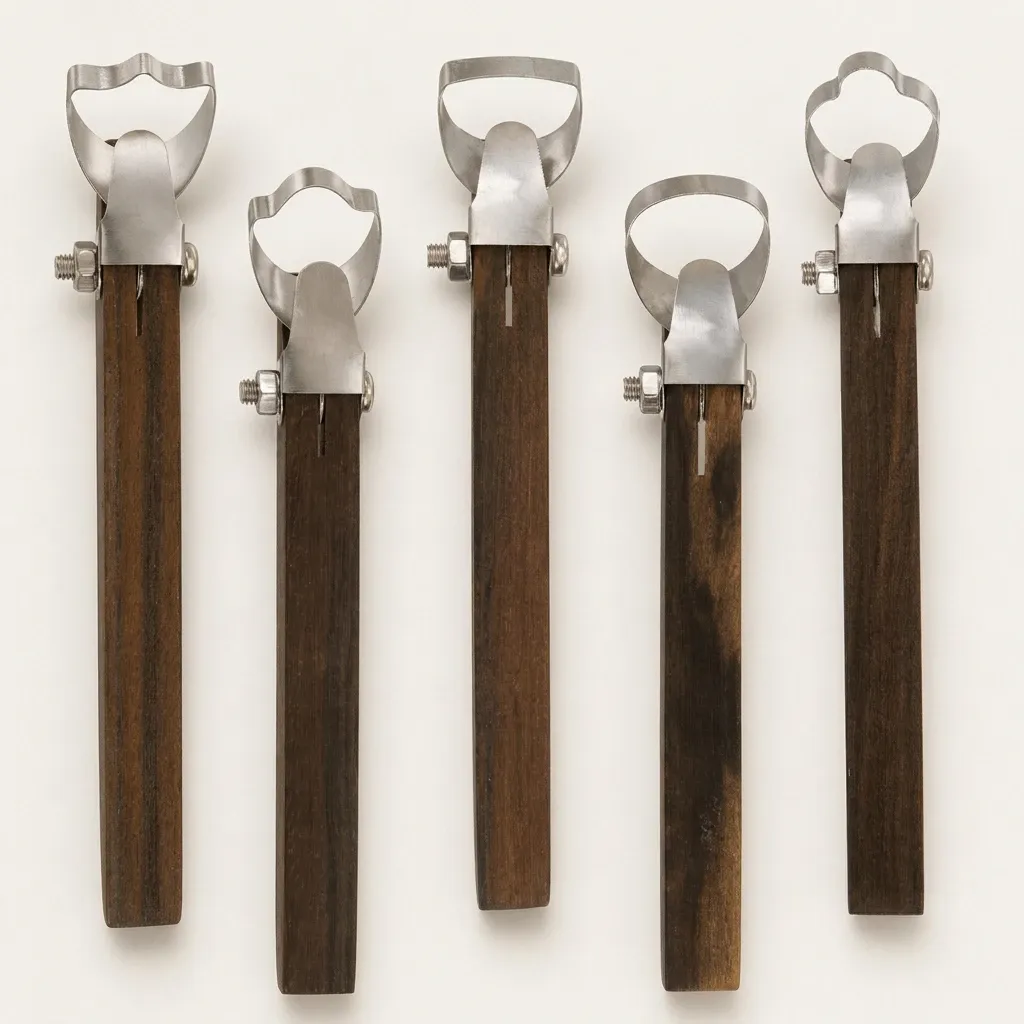
To repeat a mug handle more closely, record the starting cross-section, the cut length, the curve and the attachment positions as separate entries. The worksheet below is a proposed studio record. It is not a tested production standard, and it does not promise identical handles or crack-free joins.
Give each feature its own line
SourcingPo’s set forms a shaped strip when you press and pull the tool through soft, workable clay. The guide then says to cut the strip to length and let it firm slightly before attaching. That sequence does not state how firm the strip should be for the main bend, or how firm the mug body should be. Leave those judgements as observations in your own notes. Do not fill them with a number this record does not supply.
| Feature | What to record | Keep separate from |
|---|---|---|
| Cut blank | Profile, cut length, and width and thickness at named points, in millimetres | Measurements taken after tapering or bending |
| Hand finishing | Taper, curve and thumb-rest choices you intend to repeat | The blank dimensions |
| Attached, unfired | Opening, projection and attachment positions from a named datum | The earlier blank |
| Fired mug | The same points where you can still measure them, plus visible defects | An assumed shrinkage allowance |
A record for the next batch
- Label the profile, or keep a photograph of the head you used.
- Measure the cut strip before you taper or bend it.
- Note the curve reference you used, such as a marked outline or a tube, and record the tube diameter if you use one.
- Mark attachment points from one datum, such as the rim, and record the distances.
- After firing, compare only the points you can measure on both the unfired handle and the fired mug. If a starting measurement was never taken, write unknown.
Tania Rustage’s Tips and Tools: Foolproof Handles describes draping a shaped handle over a round tube and covering it in plastic. Joe Thompson’s Easy Handles describes cutting extruded sections and measuring the formed handle before scoring the vessel. Those are their methods. Record them only when you actually use them, and do not copy their settings onto the SourcingPo tool.
Write suspected causes of a crack, a tear or a slumped curve as hypotheses. The sheet records what you did and what you saw. For the published forming sequence, see the clay handle maker guide and the product page.
Ready to try SourcingPo?
Shop Now — £40.98